By Karen Kruse
A CHICAGO FIREHOUSE:
STORIES
OF WRIGLEYVILLE'S
ENGINE 78
By Karen Kruse

As seen in the Buffalo Grove Countryside, September 25, 2014!
By Ronnie Wachter
Staff Writer
"I hated history," the writer of a book about a piece of Chicago history said. "So I made sure that what went into the book was interesting."
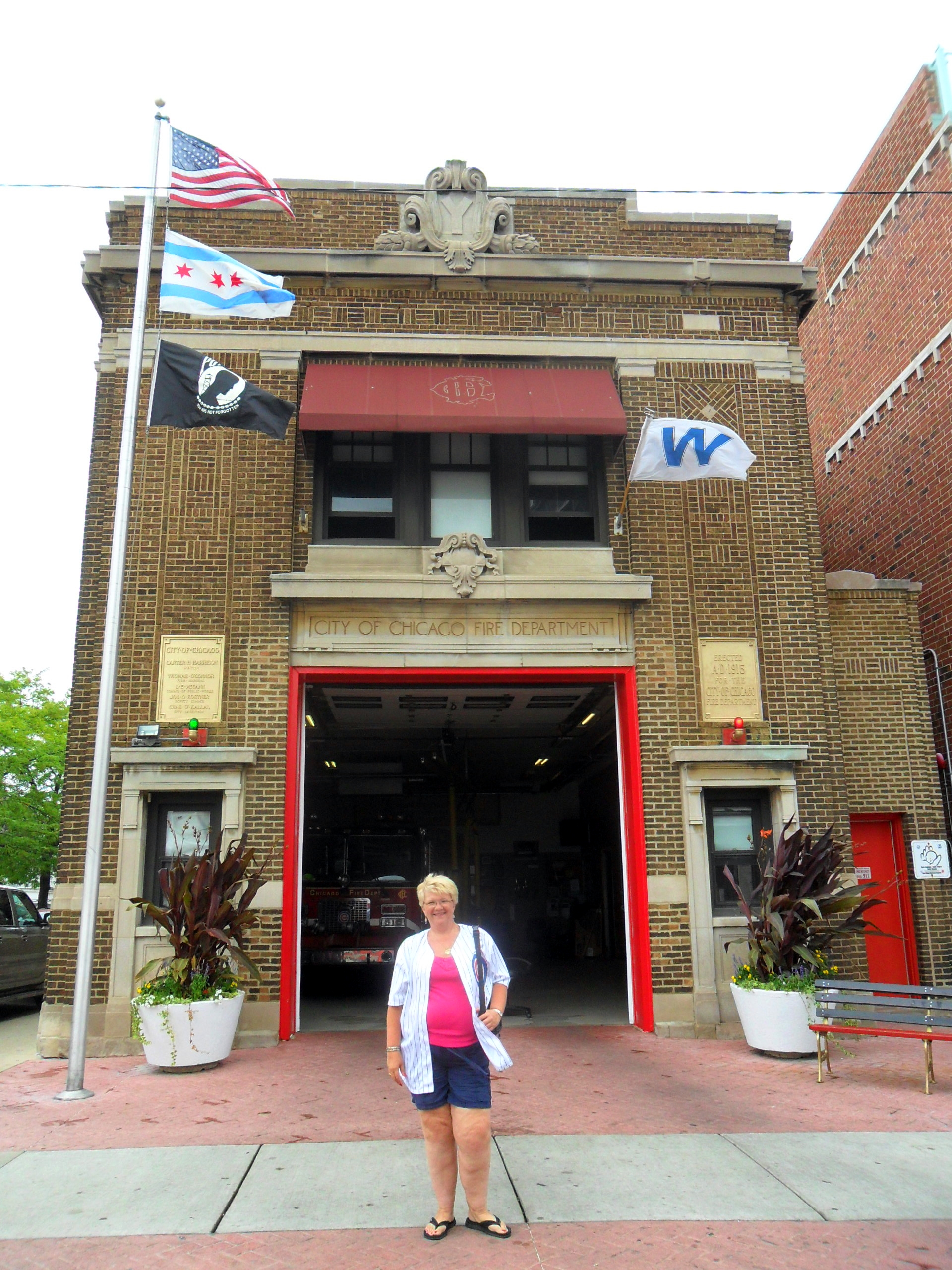
Karen Kruse, author of A Chicago Firehouse: Stories of Wrigleyville’s Engine 78 , will speak Oct. 5 for the Long Grove Historical Society about 99 years of tales surrounding the firehouse and 180 years of history in the neighborhood that became the home of the Chicago Cubs.
The daughter of a man who spent 14 of his 30 firefighting years with Engine 78, Kruse said her creation came from the love she developed as a girl for her father’s career.
“This was a man’s world,” she said of the bygone days of firefighting. “I remember when I would go to visit him, and I’d see him riding by on the back steps (of a fire truck). This was before (the Occupational Safety and Health Administration) shut that type of thing down.
“He would wave to me as he raced off to a call. That’s how a little girl falls in love with firefighting.”
“A Chicago Firehouse” is a 128-page history of life at 1052 W. Waveland Ave., since the existing building arose in 1915 to protect the year-old baseball stadium across the street. First printed in 2001 by Arcadia Publishing, the book has earned Kruse speaking invitations from libraries and historical societies around the Chicago area.
The Schaumburg resident does not tell many people that she hates history. She had to immerse herself in it to learn the tales of the workplace and home in which Capt. Robert F. Kruse served almost half of his career.
What is now the Lakeview “neighborhood” began as an independent municipality in the 1830s, when Joseph Sheffield bought two parcels of land on opposite sides of the street that now bears his name.
Chicago annexed the community in 1889 and built its first firefighting station, a frame structure with a single bay for a team of horses, on Clark Street. By 1915, much had changed in the rapidly growing area; the city set up eight new fire stations that year, including one across the street from the new stadium.
What is now the home of Engine 78 and Ambulance 6 is functionally archaic by today’s standards. It still contains just one bay, and was built without room for eating or sleeping.
But at the time of its construction, the station defined the state of that art; it never had a hay loft, because at that time Chicago was leading the nation in the switch from horsepower to motorized vehicles.
The angled brickwork helped it earn Chicago landmark status.
Kruse never found records of any major fires at Wrigley Field, she said. In fact, her father was involved in what may have been the worst.
She tells the story of May 28, 1961, when she was 3, and her mother turned the Cubs game on in the afternoon while ironing. Her mother was looking down at her work when suddenly announcer Jack Brickhouse started yelling about a commotion in the stands.
“She looked up at the TV and there was my father, putting out a hot dog stand,” she said. “When he was done, 20,000 people gave him a round of applause.”
Famous for the lovable losers that use it now, Wrigley has been the site of a few NFL Championship Games. When Mike Ditka was a Chicago Bears tight end, he would stop at the firehouse on his way to the field and eat breakfast with the crew.
Kruse was able to track down Iron Mike and scored a foreword for her book.
“My phone rang, and there was Da Coach,” she recalled.
About half of the book’s sales come from devoted Cubs fans, Kruse said. Most area suburbs are split evenly between Cubs and White Sox followers, but she prefers finding a heavily North Side crowd, she said.
“I get a lot of comments like, ‘Well, we’re Sox fans, so we don’t care,’” Kruse said.
Other sales come from the firefighting community. Even though it was a man’s world when she grew up, Kruse fell in love with it — and learning its history was her way of connecting more closely with the man who waved at her as he raced by.
“It’s been the ride of a lifetime,” she said.
As seen in the Edison-Norwood Times Review, July 22, 2010!
By Patrick Butler
Staff Writer
If you thought the hardest part about being an author was writing a book, Karen Kruse would love to set you straight.
The writing part is only the beginning.
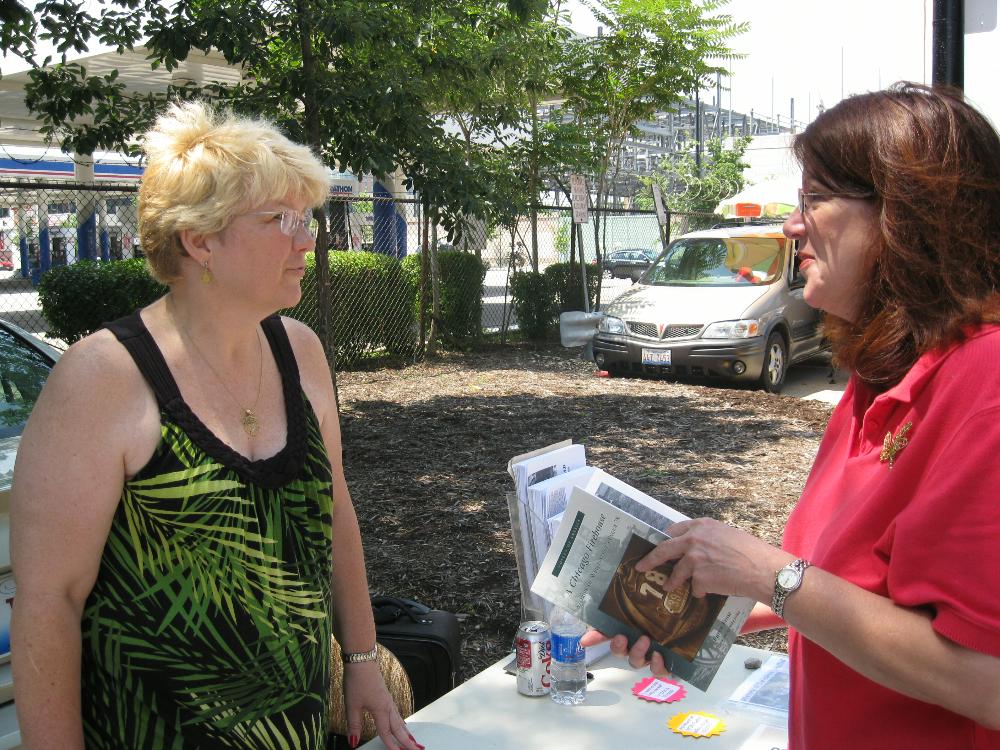
While it's true A Chicago Firehouse: Stories of Wrigleyville's Engine 78. is now in its 13th printing with more than 10,000 copies circulating around the world, the former Edison Parker and 1976 Taft High School graduate has spent nearly every free moment over most of the past decade speaking at groups like the Norwood Park Historical Society, elbowing her way onto radio talk shows, and going to just about every Chicago Fire Department-related event, including a few wakes.
At the family's request, Kruse once put a copy of the book into the coffin of a retired fireman just before he was buried at Rosehill Cemetery serveral years ago. A Chicago Firehouse was accepted by the new Library of Alexandria in Egypt and the Smithsonian Institution, but turned down by the Vatican Library, where they explained it wasn't old enough, said Kruse.
"If they had kept it, it eventually would have gotten old enough," she laughed.
She's got pins all over a world map showing the countries where someone has bought her book. Just recently, she got a request from a Scottish fireman living in New Zealand who ordered it on her Web site, www.achicagofirehouse.com.
While Kruse admits "I'd like nothing better than to have guys lined up outside my car with $20 bills," she attributes the book's popularity less to what she herself calls her "Shameless" promotion than the book's appeal to both lifelong firefighters and civilians fascinated by arcanum like: Why Chicago firehouses and vehicles have red and green lights; Why firefighters have the Maltese Cross as their symbol; and Why hydrants are called fireplugs.
The red and green lights - used to denote port and starboard sides of a vessel - were introduced by Albert Goodrich, the fire commissioner in the early 1920's who also owned a steamship company.
The Maltese Cross was an award given to Crusaders who saved comrades hit with fireballs while battling to free the Holy Land from infidels.
And fireplugs date from the days when water mains were wooden and firemen would just drill into the pipes and pump out the water, then seal the holes with plugs that could be pulled in case of any future fires on that block, Kruse explained.
Over the years, Kruse admits there have been unusual requests - like the time she was asked to kiss two copies for good luck.
"So I lipsticked up and signed both copies. I even signed one for a guy whose real name was Santa," Kruse recalled.
But there are things even she won't do, like write "Go Sox," said Kruse, whose father and grandfather both worked out of North Side firehouses.
Her grandfather, Robert Kruse, went to "drill school" with future Commissioner Robert Quinn and spent his entire career at Truck 44, now at 2718 N. Halsted. Her father, Capt. Robert F. Kruse, spent half his three decades on the job at Engine 78, 1052 W. Waveland.
But unlike a lot of other firemen's kids (or nephews for that matter), Kruse can't say she grew up in a firehouse.
"I was allowed to go to the firehouse once a year if I was lucky," she said, pointing out that because she was a girl,"this was forbidden fruit. It was a man's world you stayed out of most of the time."
"Now I get to do all kinds of cool fire stuff. I'm having a much better time now," she grinned during a recent fire fans' "muster" at the Fire Academy.
As seen in The Daily Herald, November 12, 2006, on the FRONT PAGE of the Neighbor section!
By Mary Jekielek Insprucker
Daily Herald Correspondent
After Sept. 11, 2001, there was an outpouring of thanks and praise for firefighters. However, these heroes were battling blazes of all sorts long before Al-Qaida attacked, and Schaumburg author Karen Kruse always gave them their due.
"One of the things I’m most proud of is that my book came out four months before the towers fell," Kruse said. "I knew it was important to appreciate what firefighters did and after 9/11 the rest of the world got on my bandwagon."
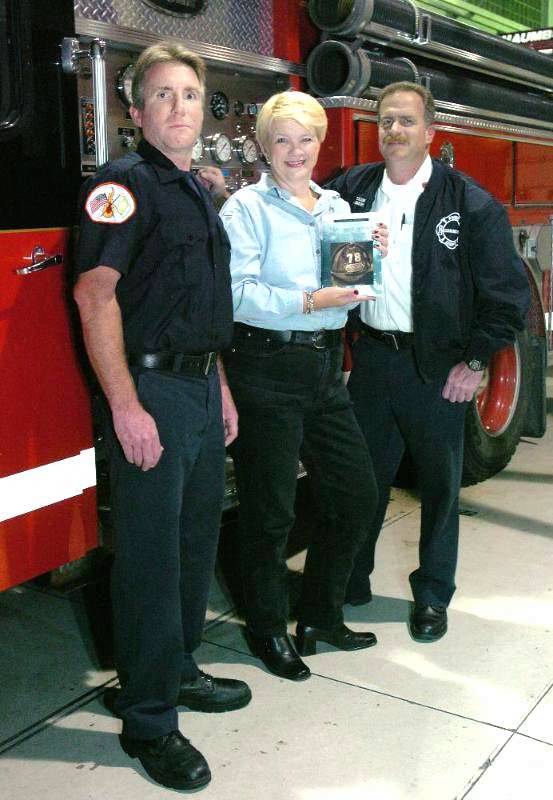
Kruse expressed her appreciation in her book, A Chicago Firehouse: Stories of Wrigleyville's Engine 78. In the book, with a foreword by Mike Ditka, Kruse chronicles life at the quaint firehouse sitting in the shadow of Wrigley Field. Using vintage photographs and stories from firefighters, Kruse captures the essence of these men and women. In addition, the book includes a civilian's guide to the Chicago Fire Department. Historic landmarks are also highlighted. However, the main focus of the book is Kruse's father, Robert Kruse.
"I wanted to write the book to honor my father," Kruse said. "I felt pushed to work on it because in his 30-year career as a firefighter he was only thanked once for his service."
"I appreciated the one thank you I received during my 30-year career from the son of the lady I saved," Robert Kruse said. "But even more I’ll always remember passing a Catholic church where the nuns and children knelt down in prayer on the sidewalk as the fire engine passed, praying for us. That one incident sticks in my mind making up for the years of no thank yous, and meant so much more."
In addition to her father, she praises others, too. About 95 percent of the families mentioned in the book, which received a 2001 Pulitzer Prize nomination in history, have thanked Kruse for honoring their loved ones.
"The most meaningful thing that has come out of the experience is that I was asked to do the eulogy for one of the firefighters in the book, who was buried with a copy of it," Kruse said.
Cpt. Frank Chambers of Schaumburg Fire Station No. 4 was also appreciative of Kruse including stories about his grandfather, Francis Chambers.
"You really only know a limited amount about your grandparents' lives, so the more I read the more intriguing I found the history," said Chambers, a Hoffman Estates resident. "I was proud to see him mentioned."
Kruse's book has enjoyed success around the world. It has been accepted at Bibliotheca Alexandrina in Egypt, the Smithsonian, and in the libraries of the Queen Mary II and Freedom of the Seas cruise ship.
"I’ve also received letters stating how much they enjoyed the book from Gov. Blagojevich, Donald Rumsfeld, and mayors Daley and Giuliani," Kruse said.
Her father, now 74, retired and living in southern Illinois, also enjoyed the book, especially one story.
"My favorite part of the book is the incident where I was pulled out of the Bowlium Bowling Alley," he said. "I was the last guy out of there, sucking in the most heat and smoke. When I was finally pulled out, I was given oxygen, but was proud we beat Engine 83 to what should have been their fire."
Chambers hopes the book helps readers comprehend what's involved in firefighting.
"I hope people who read the book come away with the realization that when they see an engine going down the street the people on it touch a lot of lives and make a difference," he said.
As seen in The Courier News, April 1, 2007, in the Fox Valley Living section!
By Mike Danahey
Staff Writer
If you are heading to the Cubs home opener on April 9, there's a good chance you will pass by a local landmark on your way into historic Wrigley Field. That other brick building you can't help but notice is the subject of A Chicago Firehouse: Stories of Wrigleyville's Engine 78, by Karen Kruse.
Kruse, who was a featured writer at the Elgin Authors Fair in late January, is the daughter of retired Chicago firefighter Robert F. Kruse, now 75, and her book is based on his first 14 years working in the famous station at 1052 W. Waveland Ave. She sees the tome as a way to honor her father's 30-year career.
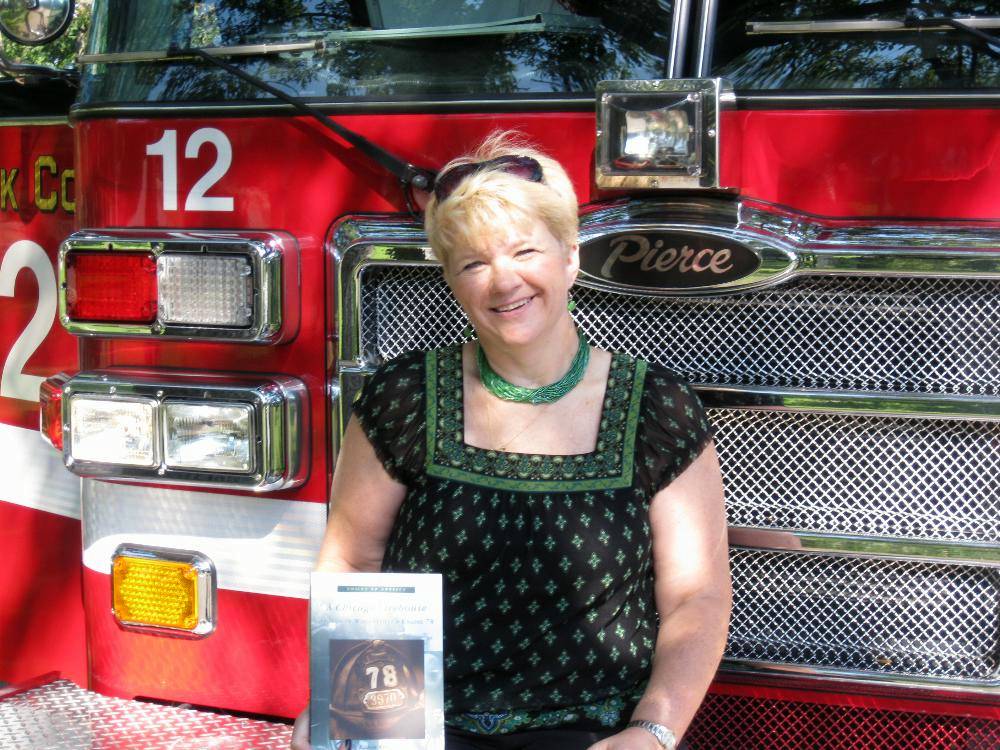
The last memorable time Kruse visited her dad's old workplace was "June 10, 2004 before a Cubs game. Joe Borowski, who used to pitch for the Cubs, is a fireman's kid. His dad, now retired, was a captain in the Bayonne (N.J.) Fire Department. He liked my book so much he gave me tickets to any Cub home game of my choice. My birthday is June 11, thus the reason for the date choice as the Cubs were out of town on my birthday. The natural thing for me to do was to visit the firehouse and get my picture taken by the rig. It was just like I was a kid again, and it felt good. Plus, the Cubbies won 12-3 with 10 runs in the 4th inning against St. Louis. It was cold and rainy, but what a game," she said.
A chapter of the book is entitled "In the Shadow of Wrigley Field," and it contains one of Kruse's favorite stories, involving a fire at the park on May 28, 1961, during a game against the San Francisco Giants.
Her father helped put out a blaze in a hot dog stand in right field. The heat was so intense it melted the coins in the cart, turning them a glowing red. And WGN cameras caught the excitement live for home viewers.
"I've had more people claim they were at the game that day. The funny thing is the Cubs only drew about 20,000 per game in those days," said Kruse.
Win or lose, the Cubs now consistently draw sellout crowds. Still, the station has to be ready to respond to calls at any minute.
"Generally during the game it isn't a problem," said Kruse. "Dad told me in years past, if they got a run during the game letting out, they would sometimes call the Fire Alarm Office to ask them not to give them any runs, if possible. That was rare though. People generally move for a fire engine."
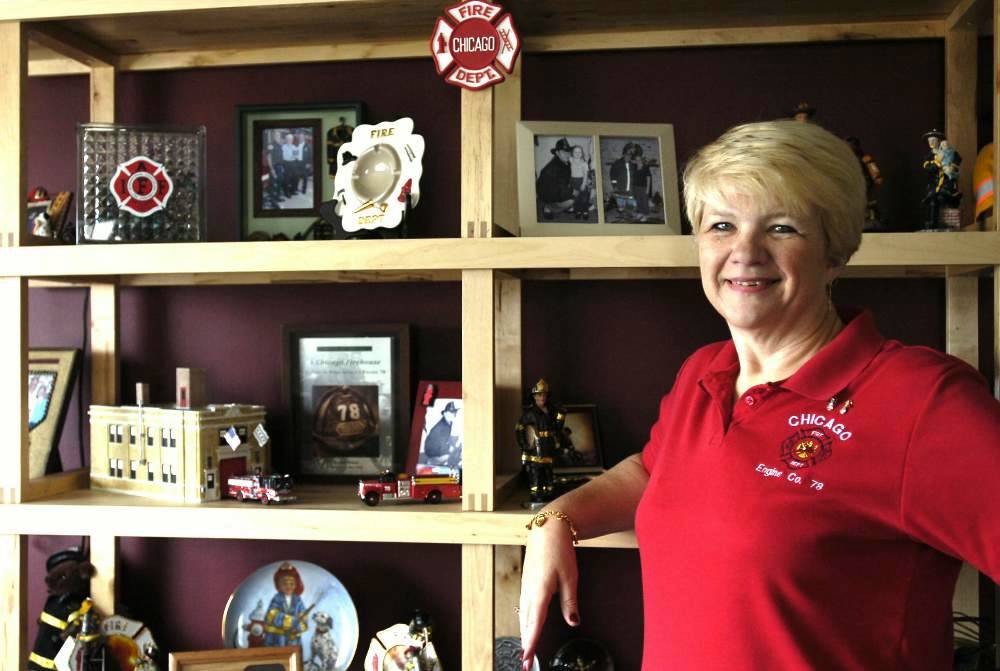
These days, Kruse lives by the new firehouse in Schaumburg, where she has "a wall of fire stuff, including a scale model of (the Wrigleyville) firehouse, I used as an oracle while writing the book. It's detailed down to the last brick," she said.
As seen in The News-Star, Oct. 7-13, 2009, on page 2!
By Patrick Butler
While Fire Commissioner John Brooks, Chaplains Fr. Thomas Mulcrone and Rabbi Moishe Wolf, Firefighters Thomas Ryan, Eileen Cogilanese of the Gold Badge Society, the “Axemen” motorcycle club, and legendary songstress Catherine O’Connell were honoring Chicago’s fallen firefighters in a Sept. 27 ceremony at Rosehill Cemetery, Karen Kruse – a descendant of three generations of “smoke eaters” quietly paid homage in her own way.
As she has done for the past nine years, a founding member of the Chicago Fire Museum discreetly worked the crowds, selling copies of “A Chicago Firehouse: Stories of Wrigleyville’s Engine 78” (Arcadia, $19.99) which she wrote as a tribute to her father – and everyone else who ever fought a fire.
“During his 30 years on the job, my father saved a lot of lives, but only got thanked once. So I’m adamant firemen should be thanked for all they do,” said Kruse, whose dad, Capt. Robert Kruse, spent half his career at the firehouse just across Waveland Avenue from Wrigley Field.
Even as a kid growing up in Edison Park, “I knew what firefighters did was very important and after 9/11, the rest of the world got on my bandwagon,” said Kruse, whose book hit the stores about four months before the Twin Towers went down.
With a thirteenth printing “imminent” and 10,000 copies in circulation everywhere from the Smithsonian and the main library in Alexandria, Egypt to the Rosehill Cemetery grave of retired fireman Joe Templeton who was buried with a copy of “A Chicago Firehouse” in his coffin, Kruse can only recall one place which declined a copy of her book – the Vatican Library. “They told me it wasn’t old enough. If they had kept it, it would eventually have gotten old enough,” she laughed.
While the book naturally appeals to firefighters and their families, Kruse said Cub fans and civilians remotely interested in Chicago trivia should also find “A Chicago Firehouse” hard to put down as they learn why all Chicago firehouses have red and green lights on their front doors, here and nowhere else, why hydrants are called fireplugs, why firemen wear the Maltese Cross on their uniforms, and what a buggyboy’s job involves.
Besides autographing Templeton’s copy just before his coffin was closed, Kruse said she’s had a number of unusual requests over the years. Like the time she was asked to kiss two copies of her book for good luck, “so I lipsticked up and kissed both copies. I even signed for a guy whose real name was Santa,” said Kruse, adding “the hardest thing to write is in memory of.” Kruse says there’s probably one thing she won’t do to sell a book. “I will not write ‘Go Sox,’” she said.
As seen in the Booster, March 17, 2004, on the FRONT PAGE!
As seen in the Booster, August 1, 2001, also on the FRONT PAGE!
By Pat Butler
Staff Writer
If you want to see Karen Kruse’s face go as bright as a Mars light, just start talking about the firehouse at 1052 W. Waveland Ave.
And while you’re at it, ask her about the gingersnaps.
You can read all about them in Kruse’s just-published A Chicago Firehouse: Stories of Wrigleyville’s Engine 78 ; (Arcadia, $19.99), which she’ll be signing at 7:30 p.m. Friday, Aug. 3, at the Barnes & Noble bookstore at 1441. W. Webster.
As far as she’s concerned, the 128-page paperback is both "a love letter from a daughter to her father" and her way of carrying on what she proudly calls "the family business."
After all, her father, Capt. Robert F. Kruse, spent half his 30 years on the job at the Waveland Avenue firehouse, while her grandfather, Robert C. Kruse (who went to "drill school" with future Commissioner Robert Quinn) spent his entire 21-year career at Truck 44, now at 2718 N. Halsted St.
A founding member of the Chicago Fire Museum, which she described as "still a work in progress," Kruse said she didn’t get to spend a lot of time hanging around firehouses when she was growing up.
"My father wouldn’t allow it. It (the firehouse) was a man’s world and girls just weren’t allowed" – except on special occasions like before going to a Cubs game across the street or if her father happened to forget something like his glasses or clean sheets and Kruse and her mother had to make an emergency delivery from their Edison Park home.
"I got to sit on the fire engine and ring the bell on the rig. If I behaved, I’d even get to blow the siren. I could have sat there forever," said Kruse, whose fascination with firefighting only grew with time.
When everyone in her class at Taft High School was asked to give a five-minute talk based on an interview with anyone they chose, Kruse interviewed her father about his firefighting career, and ended up speaking for at least 20 minutes on everything from rank and insignia, the difference between a "box," a "5-11," and a "special," and how a "still" (the neighborhood normally served by a firehouse) is covered when its regular engine or truck is out on a run.
An engine, by the way, is the apparatus that pumps water while a truck is the vehicle that carried the ladders, said Kruse, who never tires of explaining Fire Department arcanum to "civilians";
Did you know, for example:
 Why Chicago area firehouses and vehicles have red and green lights on their front doors? (The lights used to denote the port and starboard sides of a vessel were introduced by Albert Goodrich, fire commissioner from 1927-31, who also owned a steamship company.)
Why firefighters wear the Maltese Cross on their uniforms? (It dates from an award given to Crusader knights who tried to save comrades hit with naptha fireballs while battling infidels in the Holy Land.)
Why hydrants are called fireplugs? (Back when water mains were made of wood, firemen just dug a hole in the street, then drilled into the line and pumped out the water. When finished, the firemen would seal off the holes with wooden plugs that could be pulled in case of any future fires in the area.)
Kruse said the day her father reported to Engine 78, in February, 1956, he complained to the engineer about being assigned to a "crow outfit," which firemen called houses that didn’t get many calls. He soon learned otherwise. An hour and a half later, Rookie Kruse was off on his first run, to a 4-11 at the Curtiss Candy Co. headquarters at 1101 W. Belmont Ave.
Over the years, Kruse said, her father and his colleagues helped rescue victims of a November, 1956 CTA/North Shore collision near the Wilson/Broadway station; hosted a 4 ½ foot tall visiting fireman from Peru who was trying to walk around the world; and ran fire drills at Lake View High School.
Firemen she said, "have always had to have leather lungs and brass fittings." And hearts of gold.
Engine 78, after all, raised an orphan boy named Harry New York, who lived in the bunk room, went to school just like any other kid, and when it was time to strike out on his own, got a job at Wrigley Field, where he worked for more than 50 years, said Kruse, who still can’t believe her luck in getting interviews with long-retired firemen "just when I needed them."
A series of lucky happenstances ("or was it more than that?") even enabled Kruse to get the book's foreword written by former Chicago Bears Coach Mike Ditka, who often dropped by Engine 78 to visit.
"My angels all wear fire helmets," said Kruse, who decided to do a book after selling a story on Engine 78 to Victoria magazine which she described as " North Shore meets Woman's Day ."
She’s also done pieces for Fate magazine and suspects her next book "may take a more metaphysical turn," possibly exploring Fire Department-related points of interest in local cemeteries, especially Rosehill, with its Volunteer Firefighter Memorial where ceremonies are held on the anniversary of the 1871 Chicago Fire honoring firefighters and paramedics who died in the previous year.
Although firefighter John Dickey, one of 22 killed in an 1857 blaze at Lake and Water streets is buried in Graceland, Kruse said she personally considers Rosehill a more liveable place to "hang out" than the "snooty" Graceland.
Whatever direction that second book takes, however, "I’m sure I’ll be getting all the help I need," said Kruse, who has lucked her way everywhere from the pitcher’s mound at Wrigley Field, her own personal "Field of Dreams," to the cockpit of a 1943 Stearman biplane whose owner flew her over the firehouse so she could take some aerial shots.
"That sort of thing doesn’t usually happen to mortals," she added. "There must be a reason why."
 Nominated for the Pulitzer Prize in History!
To contact me, the author, click here:

To return to the Home Page, click here:

To see related links, click here:
To see my upcoming appearances and awards, click here:
To read my reviews and comments by others, click here:
To see the Chicago Sun-Times article I wrote, click here:
To learn about other pieces I've written, click here:
To read The Family Business and get a good taste of my book, click here:
To see the Foreword, Preface, and Table of Contents, click here:
To read Karen Kruse's Biography, click here: